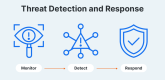
AI-Powered Cybersecurity: Threat Detection & Response Training Course
AI-Powered Cybersecurity integrates artificial intelligence with cybersecurity to enhance the detection, response, and prevention of cyber threats. This course delves into AI techniques used in identifying and mitigating these threats, providing participants with practical skills in implementing AI-driven security measures.
This instructor-led, live training (available online or onsite) is designed for beginner-level cybersecurity professionals who want to learn how to utilize AI to improve threat detection and response capabilities.
By the end of this training, participants will be able to:
- Grasp the applications of AI in cybersecurity.
- Implement AI algorithms for detecting threats.
- Automate incident response using AI tools.
- Integrate AI into existing cybersecurity systems.
Format of the Course
- Interactive lectures and discussions.
- Numerous exercises and practice sessions.
- Hands-on implementation in a live-lab environment.
Course Customization Options
- For customized training for this course, please contact us to arrange.
Course Outline
Introduction to AI in Cybersecurity
- Overview of AI in threat detection
- AI vs. traditional cybersecurity methods
- Current trends in AI-powered cybersecurity
Machine Learning for Threat Detection
- Supervised and unsupervised learning techniques
- Building predictive models for anomaly detection
- Data preprocessing and feature extraction
Natural Language Processing (NLP) in Cybersecurity
- Using NLP for phishing detection and email analysis
- Text analysis for threat intelligence
- Case studies of NLP applications in cybersecurity
Automating Incident Response with AI
- AI-driven decision-making for incident response
- Building response automation workflows
- Integrating AI with SIEM tools for real-time action
Deep Learning for Advanced Threat Detection
- Neural networks for identifying complex threats
- Implementing deep learning models for malware analysis
- Using AI to combat advanced persistent threats (APTs)
Securing AI Models in Cybersecurity
- Understanding adversarial attacks on AI systems
- Defense strategies for AI-driven security tools
- Ensuring data privacy and model integrity
Integration of AI with Cybersecurity Tools
- Integrating AI into existing cybersecurity frameworks
- AI-based threat intelligence and monitoring
- Optimizing performance of AI-powered tools
Summary and Next Steps
Requirements
- Basic understanding of cybersecurity principles
- Experience with AI and machine learning concepts
- Familiarity with network and system security
Audience
- Cybersecurity professionals
- IT security analysts
- Network administrators
Need help picking the right course?
AI-Powered Cybersecurity: Threat Detection & Response Training Course - Enquiry
Testimonials (2)
It did give me the insight what I needed :) I am starting teaching on a BTEC Level 3 qualification and wanted to widen my knowledge in this area.

Otilia Pasareti - Merthyr College
Course - Fundamentals of Corporate Cyber Warfare
Pentester skills what demonstrate teacher
Oleksii Adamovych - EY GLOBAL SERVICES (POLAND) SP Z O O
Course - Ethical Hacker
Related Courses
AdaBoost Python for Machine Learning
14 HoursThis instructor-led, live training in Uzbekistan (online or onsite) is aimed at data scientists and software engineers who wish to use AdaBoost to build boosting algorithms for machine learning with Python.
By the end of this training, participants will be able to:
- Set up the necessary development environment to start building machine learning models with AdaBoost.
- Understand the ensemble learning approach and how to implement adaptive boosting.
- Learn how to build AdaBoost models to boost machine learning algorithms in Python.
- Use hyperparameter tuning to increase the accuracy and performance of AdaBoost models.
AutoML with Auto-Keras
14 HoursThis instructor-led, live training in Uzbekistan (online or onsite) is aimed at data scientists as well as less technical persons who wish to use Auto-Keras to automate the process of selecting and optimizing a machine learning model.
By the end of this training, participants will be able to:
- Automate the process of training highly efficient machine learning models.
- Automatically search for the best parameters for deep learning models.
- Build highly accurate machine learning models.
- Use the power of machine learning to solve real-world business problems.
AutoML Essentials
14 HoursThis instructor-led, live training (online or onsite) is aimed at technical participants with a background in machine learning who wish to optimize models for detecting complex patterns in big data using AutoML frameworks.
Creating Custom Chatbots with Google AutoML
14 HoursThis instructor-led, live training in Uzbekistan (online or onsite) is aimed at participants with varying levels of expertise who wish to leverage Google's AutoML platform to build customized chatbots for various applications.
By the end of this training, participants will be able to:
- Understand the fundamentals of chatbot development.
- Navigate the Google Cloud Platform and access AutoML.
- Prepare data for training chatbot models.
- Train and evaluate custom chatbot models using AutoML.
- Deploy and integrate chatbots into various platforms and channels.
- Monitor and optimize chatbot performance over time.
Fundamentals of Corporate Cyber Warfare
14 HoursThis instructor-led, live training in Uzbekistan (online or onsite) covers the different aspects of enterprise security, from AI to database security. It also includes coverage of the latest tools, processes and mindset needed to protect from attacks.
Pattern Recognition
21 HoursThis instructor-led, live training in Uzbekistan (online or onsite) provides an introduction into the field of pattern recognition and machine learning. It touches on practical applications in statistics, computer science, signal processing, computer vision, data mining, and bioinformatics.
By the end of this training, participants will be able to:
- Apply core statistical methods to pattern recognition.
- Use key models like neural networks and kernel methods for data analysis.
- Implement advanced techniques for complex problem-solving.
- Improve prediction accuracy by combining different models.
DataRobot
7 HoursThis instructor-led, live training in Uzbekistan (online or onsite) is aimed at data scientists and data analysts who wish to automate, evaluate, and manage predictive models using DataRobot's machine learning capabilities.
By the end of this training, participants will be able to:
- Load datasets in DataRobot to analyze, assess, and quality check data.
- Build and train models to identify important variables and meet prediction targets.
- Interpret models to create valuable insights that are useful in making business decisions.
- Monitor and manage models to maintain an optimized prediction performance.
Ethical Hacker
35 HoursThis class will immerse students into an interactive environment where they will learn how to scan, test, hack, and secure their own systems. The lab-intensive setting provides each student with in-depth knowledge and practical experience with essential security systems. Students will start by understanding how perimeter defenses function and then move on to scanning and attacking their own networks—no real network is compromised. They will also learn how intruders escalate privileges and the steps that can be taken to secure a system. Additionally, students will explore Intrusion Detection, Policy Creation, Social Engineering, DDoS Attacks, Buffer Overflows, and Virus Creation. By the end of this intensive 5-day course, students will have hands-on understanding and practical experience in Ethical Hacking.
The purpose of the Ethical Hacking Training is to:
- Establish and govern minimum standards for credentialing professional information security specialists in ethical hacking measures.
- Inform the public that credentialed individuals meet or exceed these minimum standards.
- Reinforce ethical hacking as a unique and self-regulating profession.
Audience:
This course is ideal for professionals in positions such as, but not limited to:
- Security Engineers
- Security Consultants
- Security Managers
- IT Directors/Managers
- Security Auditors
- IT Systems Administrators
- IT Network Administrators
- Network Architects
- Developers
Google Cloud AutoML
7 HoursThis instructor-led, live training in Uzbekistan (online or onsite) is aimed at data scientists, data analysts, and developers who wish to explore AutoML products and features to create and deploy custom ML training models with minimal effort.
By the end of this training, participants will be able to:
- Explore the AutoML product line to implement different services for various data types.
- Prepare and label datasets to create custom ML models.
- Train and manage models to produce accurate and fair machine learning models.
- Make predictions using trained models to meet business objectives and needs.
Certified Lead Ethical Hacker
35 HoursWhy should you attend?
The Certified Lead Ethical Hacker training course equips you with the essential expertise to conduct information system penetration tests using recognized principles, procedures, and techniques. This helps identify potential threats on a computer network. Throughout the course, you will acquire the knowledge and skills needed to manage a penetration testing project or team, as well as plan and execute both internal and external pentests, in line with standards such as the Penetration Testing Execution Standard (PTES) and the Open Source Security Testing Methodology Manual (OSSTMM). Additionally, you will gain a comprehensive understanding of how to draft reports and propose countermeasures. Through practical exercises, you will master penetration testing techniques and develop the skills required to manage a pentest team, handle customer communication, and resolve conflicts.
The Certified Lead Ethical Hacking training course offers a technical perspective on information security through ethical hacking, utilizing common methods like information gathering and vulnerability detection, both within and outside of business networks.
This training aligns with the NICE (The National Initiative for Cybersecurity Education) Protect and Defend framework.
After acquiring the necessary knowledge and skills in ethical hacking, you can sit for the exam and apply for the "PECB Certified Lead Ethical Hacker" credential. Holding a PECB Lead Ethical Hacker certificate will demonstrate your proficiency in performing and managing penetration tests according to best practices.
Who should attend?
- Individuals interested in IT Security, especially in Ethical Hacking, whether to deepen their understanding or embark on a career change.
- Information security officers and professionals aiming to master ethical hacking and penetration testing techniques.
- Managers or consultants looking to gain control over the penetration testing process.
- Auditors who wish to conduct professional penetration tests.
- Those responsible for securing information systems within an organization.
- Technical experts interested in learning how to prepare a pentest.
- Cybersecurity professionals and members of information security teams.
MasterClass Certified Ethical Hacker Program
28 HoursThe Certified Ethical Hacker certification is highly sought after in the field of cybersecurity worldwide.
This program combines instruction and practical exercises to prepare students for both the CEH certification exam and the CEH Practical Exam. Successfully passing both exams will earn candidates the prestigious CEH Master credential along with their CEH certification.
Students have the option to add either the CPENT or the CHFI course to their package.
Each student will receive training for either the Certified Penetration Testing Professional (CPENT) course or the Computer Hacking Forensic Investigator (CHFI) course through EC-Council’s online, self-paced, streaming video program.
CPENT (Pen-test):
This course teaches students how to apply the concepts and tools from the CEH program to a penetration testing methodology in a live cyber range environment.
CHFI (Computer Forensics):
This course provides a methodological approach to computer forensics, including techniques for searching and seizing evidence, maintaining the chain of custody, acquiring, preserving, analyzing, and reporting digital evidence.
Course Description
The CEH program offers an in-depth understanding of ethical hacking phases, various attack vectors, and preventive countermeasures. It teaches you how hackers think and act maliciously so that you can better position yourself to set up your security infrastructure and defend against future attacks. Understanding system weaknesses and vulnerabilities helps organizations strengthen their system security controls to minimize the risk of an incident.
The CEH program is designed with a hands-on approach and systematic process across each ethical hacking domain and methodology, providing you with the opportunity to demonstrate the knowledge and skills needed to achieve the CEH credential. You will gain a new perspective on the responsibilities and measures required to ensure security.
Who Should Attend
- Law enforcement personnel
- System administrators
- Security officers
- Defense and military personnel
- Legal professionals
- Bankers
- Security professionals
About the Certified Ethical Hacker Master
To earn the CEH Master certification, you must pass the CEH Practical exam. The CEH Practical Exam is designed to test students' ability to apply the principles taught in the CEH course. This practical exam requires you to demonstrate your skills in ethical hacking techniques such as threat vector identification, network scanning, OS detection, vulnerability analysis, system hacking, and more.
The CEH Practical Exam does not involve simulations. Instead, you will face a live range that mimics a corporate network using live virtual machines, networks, and applications.
Successfully completing the challenges in the CEH Practical Exam is the next step after obtaining the Certified Ethical Hacker (CEH) certification. Passing both the CEH exam and the CEH Practical will earn you the additional certification of CEH Master.
About the Certified Ethical Hacker Practical
To demonstrate your skills in ethical hacking, we test your abilities with real-world challenges in a live environment. You will use labs and tools to complete specific ethical hacking tasks within a time limit, just as you would encounter in the real world.
The EC-Council CEH (Practical) exam features a complex network that replicates a large organization’s real-life network, including various systems such as DMZs and firewalls. You must apply your ethical hacking skills to discover and exploit real-time vulnerabilities while also auditing the systems.
About CPENT
EC-Council’s Certified Penetration Tester (CPENT) program focuses on penetration testing in an enterprise network environment. It teaches you how to attack, exploit, evade, and defend such networks. If you have only worked with flat networks, CPENT’s live practice range will elevate your skills by teaching you to test IoT systems, OT systems, write your own exploits, build tools, conduct advanced binary exploitation, double pivot to access hidden networks, and customize scripts and exploits to penetrate the innermost segments of a network.
About CHFI
The Computer Hacking Forensic Investigator (CHFI) course provides a vendor-neutral perspective on digital forensics. It covers major forensic investigation scenarios and equips students with hands-on experience in various forensic techniques and standard tools necessary for conducting successful computer forensic investigations.
Machine Learning for Mobile Apps using Google’s ML Kit
14 HoursThis instructor-led, live training in (online or onsite) is aimed at developers who wish to use Google’s ML Kit to build machine learning models that are optimized for processing on mobile devices.
By the end of this training, participants will be able to:
- Set up the necessary development environment to start developing machine learning features for mobile apps.
- Integrate new machine learning technologies into Android and iOS apps using the ML Kit APIs.
- Enhance and optimize existing apps using the ML Kit SDK for on-device processing and deployment.
Machine Learning with Random Forest
14 HoursThis instructor-led, live training in Uzbekistan (online or onsite) is aimed at data scientists and software engineers who wish to use Random Forest to build machine learning algorithms for large datasets.
By the end of this training, participants will be able to:
- Set up the necessary development environment to start building machine learning models with Random forest.
- Understand the advantages of Random Forest and how to implement it to resolve classification and regression problems.
- Learn how to handle large datasets and interpret multiple decision trees in Random Forest.
- Evaluate and optimize machine learning model performance by tuning the hyperparameters.
Advanced Analytics with RapidMiner
14 HoursThis instructor-led, live training in Uzbekistan (online or onsite) is aimed at intermediate-level data analysts who wish to learn how to use RapidMiner to estimate and project values and utilize analytical tools for time series forecasting.
By the end of this training, participants will be able to:
- Learn to apply the CRISP-DM methodology, select appropriate machine learning algorithms, and enhance model construction and performance.
- Use RapidMiner to estimate and project values, and utilize analytical tools for time series forecasting.
RapidMiner for Machine Learning and Predictive Analytics
14 HoursRapidMiner is an open-source data science software platform designed for quick application prototyping and development. It provides an integrated environment for data preparation, machine learning, deep learning, text mining, and predictive analytics.
In this instructor-led, live training, participants will learn how to use RapidMiner Studio for data preparation, machine learning, and the deployment of predictive models.
By the end of this training, participants will be able to:
- Install and configure RapidMiner
- Prepare and visualize data using RapidMiner
- Validate machine learning models
- Mash up data and create predictive models
- Operationalize predictive analytics within a business process
- Troubleshoot and optimize RapidMiner
Audience
- Data scientists
- Engineers
- Developers
Format of the Course
- Part lecture, part discussion, exercises, and extensive hands-on practice
Note
- To request a customized training for this course, please contact us to arrange.