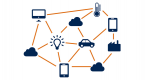
Connected devices are disrupting many industries, and the power utility sector is no exception. Power utility companies currently face four key challenges stemming from the growth of the Internet of Things (IoT):
-
Machines, controllers, HMI, and SCADA systems are increasingly being connected to the cloud by vendors promising enhanced analytics and insights for predictive and preventative maintenance. However, quarantine policies surrounding critical assets mean that power companies cannot utilize these new IoT features offered by machine and controller vendors.
-
With the continuously decreasing cost of solar and wind power microgrids, utility companies will soon experience declining revenue from power generation. To compensate for lost production revenue, companies must aggressively pursue new revenue streams, such as Home Energy Management as a Service, Energy Storage as a Service, grid services for EV charging, peer-to-peer (P2P) energy trading between homes, microgrid-to-microgrid exchanges, microgrid-to-battery interactions, and home-to-battery solutions. All of this must be enabled through smart metering, smart grids, and secure transactions, which are only possible via Distributed Ledger Technology (DLT) like IOTA. Additionally, utilities are exploring the provision of smart city services to local authorities.
-
For critical infrastructure such as dams, the International Committee of Large Dams (ICOLD) requires real-time Structural Health Monitoring (SHM). This ensures that any impending danger of dam, rock, or tunnel collapse can be detected in advance, allowing affected populations to be evacuated promptly.
-
A new emerging revenue area is EV charging in parking facilities. How can IoT facilitate smart charging and smart parking solutions?
Over the past three years, IoT engineering has undergone massive changes, primarily driven by Microsoft, Google, and Amazon. These industry giants have invested billions of dollars to develop more manageable and secure IoT platforms. Furthermore, IoT Edge has gained significant momentum in both research and deployment, becoming the only viable path for practical IoT implementation. With 5G promising to transform the IoT business landscape, there has been an unprecedented surge in research funding for new IoT areas. Consequently, it is absolutely essential for any practicing engineer to understand the IoT platforms developed by major players like AWS, Google, and especially Microsoft.
However, none of the aforementioned platforms offer a fully exhaustive or comprehensive solution for scalable IoT. For instance, deploying smart metering to millions of homes requires additional technologies to secure the meters, radio networks, IoT management solutions, and various other secure services. The strategy, pricing, and security of any IoT deployment must be optimal and acceptable. Given the vast amount of interdisciplinary knowledge required, it is nearly impossible for any single company to assemble a team capable of meeting all these requirements.
This course is a modest attempt to educate key decision-makers, developers, and security experts about the challenges, risks, and practical methods for deploying IoT in next-generation power utility businesses.
In addition, as deployments scale, managing IoT services for thousands of sensors and connections has emerged as a distinct field of engineering research. Known formally as Managed IoT Services, this area is experiencing rapid growth because the challenges of scaling IoT are far greater than simply building it. This includes securing over-the-top firmware and software updates, managing sensor and system calibration, auto-diagnosing connection issues, pinpointing the root causes of API failures, and tracking the hardware and service health of distributed systems.
Course objectives
The main objective of the course is to introduce emerging technological options, platforms, and case studies regarding IoT implementation in power utility companies, covering Smart Metering, Smart Cars, Structural Health Monitoring (SHM), Power Quality Diagnosis, and Smart Contracts. It provides a basic introduction to all elements of IoT, including mechanical and electronics/sensor platforms, wireless and wireline protocols, mobile-to-electronics integration, mobile-to-enterprise integration, data analytics, and control plane applications.
-
IoT Technology Stacks: Devices, Gateways, Edge, Edge Cloud, Public Cloud, IoT Databases, Web & Mobile Applications for IoT, and Centralized vs. Decentralized IoT.
-
IoT Ecosystem for Business: Third-party device management and risk management across the entire IoT ecosystem.
-
M2M Wireless Protocols for IoT: WiFi, SigFox, LORA, LPWAN, Zigbee/Zwave, Bluetooth, ANT+ – Guidance on when and where to use each protocol.
-
Fundamentals of IoT Gateways: Risks, management, and ecosystem considerations.
-
Mobile/Desktop/Web Apps for registration, data acquisition, and control – Overview of available M2M data acquisition platforms for IoT such as AWS IoT, Azure IoT, and Google IoT.
-
Security Issues and Solutions for IoT: A comprehensive review of security across all technology stacks.
-
Enterprise IoT Platforms: Including Microsoft Azure IoT Suites, AWS IoT, Google IoT, and Siemens MindSphere.
-
Smart Metering: Open Smart Grid Protocols (OSGP), ANSI C 2.18 Protocols, NIST Standards for HAN (Home Area Network), HomePlug Powerline Alliance, and the IEC 62056 Security Standard for Smart Meters.
-
Distributed Ledger Technology (DLT): Including Blockchain, HyperLedger, and DAG (Directed Acyclic Graph) for smart contracts, P2P transactions, and smart car charging.
-
IoT for Critical Infrastructure: Applications for dams, transformers, substations, and high-tension wires.
Read more...